
IT project failure has become a very common factor
during past 10 years, most IT projects
today face the problem of getting cancelled their project before completion or
abandon their project in the
implementing stage itself. Researches continuously shows that most companies
have the difficulty of completing IT projects successfully .
“For 2004 results show that 29% of all projects
succeeded (delivered on time, on budget, with required features and functions);
53% are challenged (late, over budget and/or with less than the required
features and functions); and 18% have failed (cancelled prior to completion or
delivered and never used). A staggering 66% of IT projects prove unsuccessful
in some measure, whether they fail completely, exceed their allotted budget,
aren't completed according to schedule or are rolled out with fewer features
and functions than promised.” (Chaos, 2004)
This leads to the question why do
IT projects fail despite of the all the technology improvement and enhancement,
therefore author would like to discuss this matter with the recent IT project failures and disasters.
·
2004 Avis
Europe PLC enterprise resource planning (ERP) project was terminated its
development after causing £30m loss.
According
to the company statement it state that
they have abounded the project
due to the high cost and delays. (Thomas,
2004)
·
An IT phone system was launched in April
2003, two years late and £56 million pounds over budget. The 1.2 million
existing cases could not be transferred on to the new system because it failed
to work. (Charette)
·
Sydney Water Corp, billing system to
automate customer information and billing for Australia's largest water
provider is canceled in 2002, due to inadequate planning, numerous change
requests, and cost and schedule overruns, which leads to the loss of $33.2
million. (Robert N. Charette)
·
London Stock an exchange Failure- Effort to design new
stock settlement system is scrapped in 1993, after seven years, because of
overly complex and cumbersome design and poor project management, , which leads
to the loss of $600 million. (Robert N.
Charette)
·
In 2005 US Justice Department Inspector
General report stated $170m FBI Virtual Case File project was a failure, after
five years and $104m in expenditures . (Frieden,
2005)
After analyzing all the factors which were affected
to fail the VCF project these factors had a major impact on failing the
project.
o Unrealistic or
unarticulated project goals
o Inaccurate
estimates of needed resources
o Badly defined
system requirements
o Poor reporting
of the project's status
o Unmanaged risks
o Poor
communication among customers, developers, and users
o Use of immature
technology
o Inability to
handle the project's complexity
o Sloppy
development practices
o Poor project
management
(Robert N. Charette)
All these above factors comes under poor project
management, project manager should be able to set up realistic project goals , and estimate the
needed resources appropriately . And for VCF project, it has a major issue on
requirement gathering and controlling requirements , this can be handled in the
project management stage itself, project manager should be able to control the
requirements and properly manage the requirement management team. Therefore
project manager should be able to manage risks even If there are technical
issues, and should be able to tackle the situation smoothly.
From the above research on failed IT projects author
come to the conclusion of poor project management is a key factor of a project
life cycle and shortcomings in project
management are more of a threat to the success of the software industry today
than technical issues.
Technical issue that a project face which can lead a
project to fail can be categorized as
- Inappropriate architecture;
- Insufficient reuse of existing technical objects;
- Inappropriate testing tools;
- Inappropriate coding language;
- Inappropriate technical methodologies;
- Lack of formal technical standards;
- Lack of technical innovation (obsolescence);
- Misstatement of technical risk;
- Obsolescence of technology;
- Poor quality code;
- Poor systems testing;
- Poor systems integration;
- Poor configuration management;
- Poor change management procedures;
- Poor technical judgment (McManus, 2008).
All these above difficulties can overcome by the
technical team if the project management is strong and capable of managing the
risk appropriately. And most of the projects rely on the decisions that were
made in all stages of software development life circle which is a responsible
of project management, and it is project managers responsibility to allocated
the limited resources appropriately.
“Most public firms have written off failed IT
projects in the past year, typically due to poor project management, according
to a new report from KPMG.” (ElectricNews.net,
2002)
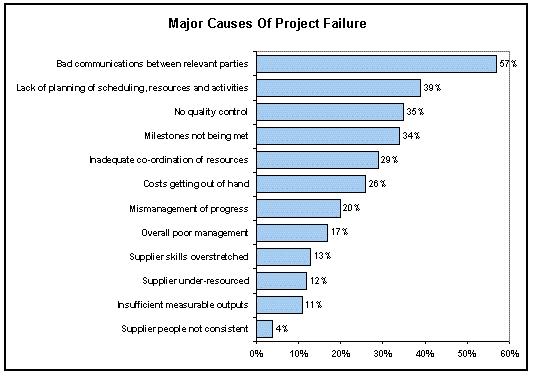
Bull Survey,(1998),Failure Causes.[online] Available From
<
http://www.it-cortex.com/Stat_Failure_Cause.htm
> [Accessed on 19th
October 2008]
From
the above statistics shows that major causes of project failure during the
lifecycle of the project are a breakdown
in communications (57%), a lack
of planning (39%) and poor
quality control (35%). (The Bull Survey,
1998).Proper communications , project planning and quality control can
be done using proper project management skills, this reveals that the basic factors which leads to
a project failure is on project management’s hand.
From
the above facts author come to the conclusion of proper project management
is the key fact for a project to be
successful .There are many more projects which have failed due to bad
performance in project management which had lack of managements skills, such as
project planning, monitoring of
project progress, risk management, as a results most assigned project managers lack the experience in
handling a broad range of problems that arise during the course of a project
and leads to unsuccessful projects. Therefore author suggest effective project management with senior management
reviews / involvement and proper time, cost, resource management skills can
decrease the number of project failur


